What Filetype to Upload Maps to Roll20
This is a rundown of several practices that'll ensure the optimal playing feel. Following this guideline should cutting down on image load fourth dimension, make it easier to employ your own files on the tabletop, and should ensure that your files are the all-time quality and operation.
You tin can meet how much of your Storage Quota is left from your Account page.
Contents
- 1 Sound Files
- 2 Images and Animations
- 2.1 Spider web-Friendly vs. Print Images
- two.2 File Types
- ii.ii.ane Prototype Files
- 2.2.2 Animation Files
- ii.iii Working with Screen Space
- 2.iv Roll20 Image Dimensions
- 2.5 Token Images
- 2.vi Troubleshooting Image Problems
- 3 See Also
Audio Files
Roll20 now supports using your own music on the virtual table acme, by uploading it to the u Jukebox.
The four bachelor sound file types that are officially supported in Roll20 are mp3, ogg, wav, flac. Audio uploads have a maximum upload size of 20MB. Below is a nautical chart comparing the file formats against each other:
| File Blazon | File Size | File Blazon Pros | File Blazon Cons |
| mp3 | low | Very minor file size, short processing times | Lower quality audio, "tinny" or digital tone |
| ogg | boilerplate | Efficient storage type | Slight reduction in sound quality, but likely not noticeable to nearly users. |
| wav | high | Has been around for a long time, many assets bachelor | Not specially efficient storage, and is a raw file type, meaning yous don't leverage the gains from the last twenty years of technological advances. |
| flac | loftier | Lossless compression - high quality audio | Loftier fidelity audio files are very large, and crave longer to procedure. Files volition be downsampled for use in the VTT. |
Images and Animations
Spider web-Friendly vs. Print Images
If you're playing from a commercial adventure pack, there's a high chance you're working from a PDF file which is often published with the intended purpose of being printed out afterward by the user. In order for graphics to be readable and crisp for print, the image resolution - the DPI (Dots per inch) has to be kept rather loftier. The standard minimum resolution for a printed prototype is roughly 300 DPI. The college the DPI, the larger the image'south file size is and the harder a processor has to work to brandish the prototype. The graphics contained within a PDF such as maps, character portraits and handouts aren't designed for web, they're designed for print. We recommend that they shouldn't be dragged directly from a PDF file and into a Roll20 Game.
Paradigm resolution is meaningless to how an epitome displays on the screen. The deciding factor of how an paradigm displays on screen is determined past the dimensions of the image. A 500 pixel loftier by 300 pixel wide image volition display on screen as 500 pixels by 300 pixels regardless if it's 75 DPI, 200 DPI, 600 DPI and so on. When you're working with images over the internet, the higher the DPI means there's more needless data that needs to exist transferred which will irksome your game down.
If you want images to run smoothly in Roll20, keep image resolution low. The standard for web has been 72/75 DPI since the dawn of graphical web sites. Anywhere betwixt the 70-150 DPI range should be adequate for your game images.
File Types
Image Files
Available image file types that can exist imported and used in Roll20 are JPG, PNG, GIF. Image uploads take a maximum upload size of 10MB to
Pro
info and
Plus
info users, while free users are restricted to 5MB. Below is a chart comparing the file formats against each other:
| File Blazon | Transparency Availability | Translucency Availability | File Size | File Type Pros | File Type Cons |
| JPG | No | No | Boilerplate | Smoothen gradients, small-scale file size, preferred file blazon in Roll20 | No transparency options, quality can suffer when heavily compressed. |
| GIF | Yes | No | Smallest | Palette swatch command, cracking for pixel art, animated gifs will animate on the Roll20 virtual table top. | Poor quality with gradients, simply 256 colors, not advised for realistic images. |
| PNG | Yeah | Yes | Largest | Lossless pinch - high quality images | File size inflates when using all-encompassing alpha channel piece of work, large files can use upward a lot of system resources. Does everything except animations that a GIF tin exercise, plus more. Ideal format for solid drawings, images with large swaths of exactly the same colour. |
Note: Due to the way that images are parsed by Roll20, the ".jpeg" extension is not recognized. Brand sure JPG files use the extension ".jpg". No re-salve is necessary, just edit the name.
Animation Files
Animations are supported on Roll20 in three file types gif, mp4, webm. IImage uploads have a maximum upload size of 10MB to
Pro
info and
Plus
info users, while free users are restricted to 5MB. Below is a chart comparison the file formats against each other:
| File Type | Transparency Availability | Translucency Availability | File Size | File Type Pros | File Type Cons |
| GIF | Yes | No | Small, simply Inefficient | Palette swatch control, cracking for modest or simple animations. GIF files are typically smaller than other animation types. | Considering they store more than information per blitheness frame than other formats, large animations perform poorly. Poor quality with gradients, not advised for realistic animations. |
| mp4 | No | No | Large, better efficiency | These are actually video file formats, which translate to better experience. Transparency (called an Alpha channel) is not supported by this file type. Animated maps and backgrounds work well in this file type. In one case uploaded to Roll20, these files volition not retain sound from the original file. | No transparency options, quality can endure when heavily compressed |
| webm | Yes | Yes | Small, well-nigh efficient | Engineered for use on the spider web. Supports transparency and translucency (with eight-bit Alpha Channel). As much quality as mp4 in a much smaller size | This file type is not as universal as mp4 or GIF. |
If you take graphics that don't require any transparency or translucency, stick with JPG images files. For animations, the mp4 files will exist more available, just converting mp4 to webm will reduce the time it takes to put files on Roll20. The GIF file type is handy if y'all want just a simple aliased cutout image for token objects, with or with blitheness. PNGs can also work for token objects or images requiring transparency, but blithe PNG files are not supported. As PNGs are more flexible than GIFs, sometimes they will take a larger file size for what looks to the centre like the same image.
If your software controls information technology, you may be able to change your prototype from "full colour" or "rgb" to "palette" or "indexed". The latter only has a limited number (usually 256) of colors, and is the but format that GIF supports. This is why GIF files are smaller; PNG files using the aforementioned type of palette will be roughly the same size as GIF images (or, if anything a fleck smaller). Well-nigh PNG files y'all create will be rgb, saving more data per pixel than GIF, and thus being bigger-- but also preserving more than paradigm integrity.
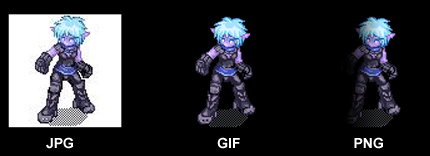
Transparency with JPG, GIF, and PNG Files
Working with Screen Infinite
When a GM hands out documents to their players effectually a physical table, oft the item is written or printed on portrait-oriented paper. On a tablet, a person can only flip the screen whether a graphic is either Portrait or Mural. This can't actually exist done on a computer monitor. When y'all want to create handouts or splash screens for use in Roll20, keep in mind that the average user often is working on a widescreen monitor with fixed screen resolution (not to be confused with image resolution). You want to create and plan out handouts and splash screens that'll fit nicely on the collective user's screen. Instead of thinking portrait, become with landscape orientation for notes, messages, and pictures or anything else that isn't going to be a tabletop map.
Regarding screen resolution, get an idea of what your players are using. Are they working at desktop stations? Tablets? Laptops? Discover a happy medium of screen resolution and piece of work your graphic sizing around that, and so no one will have to play with their zoom settings and then they tin can view your images. Websites like w3schools.com proceed yearly tallies of the boilerplate screen resolution over the years if you need a generic pattern guide.
Roll20 Epitome Dimensions
Here'south specific Roll20 dimensions for certain graphic elements.
| UI Element | Pixel Width | Pixel Height |
| Grid Square | 70px | 70px |
| Hex Unit of measurement (Vertical)* | ~75px | ~88px |
| Hex Unit (Horizontal)* | ~94px | ~81px |
| Max Character Portrait Size | 250px | No Height Constraint |
| Game Details Icon | 300px | 512px |
| Rollable Table Images (Text Chat) | 30px | 30px |
* The hex filigree is mathematically drawn, so the pixel meridian and width for a single hex unit is an approximation
Token Images
Token images, due to their pocket-size size, are probably best suited for PNG formats (if yous want transparency) for best quality. If you're non relying on a square or hex grid to move tokens about the tabletop, you don't need to concern yourself about the actual dimensions of the epitome. If you lot are using a grid; however, you lot'll desire to make certain your prototype has enough transparent padding. The reason for doing this is that an image when dropped onto a gridded tabletop will warp the dimensions of the image to best sit inside a single grid unit of measurement. This process might dramatically modify the proportions of your image. For instance, if you're using tokens that fill a 1 x 1, 2 x 2 or 3 10 iii unit space, you'll want to brand sure that the final dimensions of the image are the same for both height and width. If you have an oblong token, you'll desire to make sure that the final dimension'due south of either the width or height is exactly double or maybe triple of the other.
Troubleshooting Image Problems
Common Trouble:
"Why is it taking Roll20 forever to zoom or pan across a map?"
"When I endeavor to zoom in by 100%, my map just disappears."
"Images are taking forever to appear for some or all of my players."
Solution:
This is usually due to file size of any given image in a game. Check the file size of the images you lot're using for your game. If any prototype is over a megabyte in size, we'd recommend checking its paradigm resolution and decrease it in an image editing software package. Too, brand sure you lot're using the right file type to minimize file size. Merely use PNGs when you lot need transparencies*.
* Unless you are using monochrome PNGs, then file size / bandwidth functioning rocks. PNG is the smallest possible file format using GIMP & 1 bit color depth. A 7000x7000 empty map is 7k as PNG, 32k as GIF, 281kb as JPG. It gets worse after adding bodily information. A more practical comparison for an actual map is 92k (png), 206kb (gif), 729kb(jpg). For my Ad&D iii.5 game, I plan epitome size around the 70x70 pixel unit square & size my maps to multiples thereof. Later completing the map, I catechumen it to one-bit indexed color. I create a new page where the units are image_x / lxx * image_y / 70, & drag the picture over. It flies over & I take seen no operation issues yet. Oh yeah, I am using DSL.
Common Problem:
"My players are having a difficult fourth dimension reading my manus written note, why does the preview wait and so small?"
Solution:
Continue in mind that the limits of a role player's screen when you lot're creating handouts. Effort to make as much utilize of the available screen space. This normally means designing items that are wider than they are tall to all-time fit on a widescreen monitor.
Common Trouble:
"When I dropped my token art onto the table, the dimensions of the image got really messed upwards."
Solution:
Sounds like your image you are using for your token didn't have enough padding. Make certain you add together padding around your Token graphics so that they're square or are using the advisable dimensions to place on the grid. For instance, a creature that you desire to take upward a 2x1 grid expanse, make certain one dimension of the image is padded out to exist exactly double of the other. This volition ensure that your paradigm'southward proportions are retained and y'all'll be able to view the image as expected once on the grid.
See Also
- Optimizing Roll20 Performance
- (Legacy) Dynamic Lightning - Best Operation Guide
- Updated Dynamic Lighting
Source: https://wiki.roll20.net/Best_Practices_for_Files_on_Roll20
0 Response to "What Filetype to Upload Maps to Roll20"
Post a Comment